A dental appointment should leave you with answers, not uncertainty. If you are considering digital dental scans in Deer Park, they can help your dentist show you what is happening in your mouth, explain the options clearly and plan care around your needs.
For busy families, anxious patients and anyone managing a tooth problem, being able to see a clear image can make a real difference. Digital scanning is not about adding technology for its own sake. It is about making examinations more comfortable, treatment planning more accurate and decisions easier to understand.
What are digital dental scans?
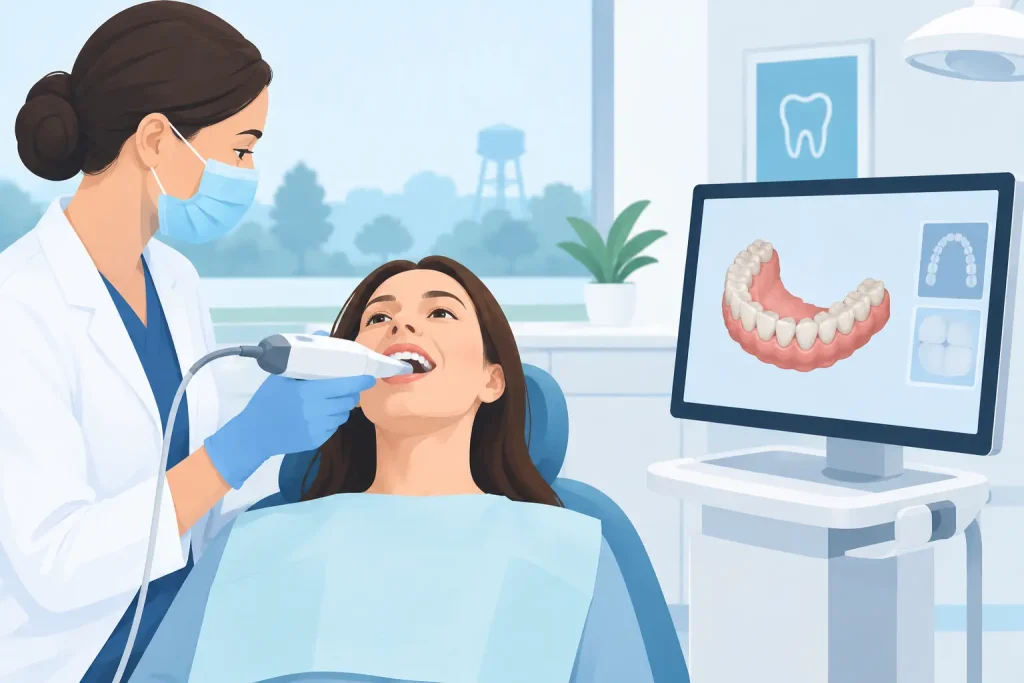
Digital dental scans create detailed images of your teeth, gums and bite without the need for traditional mould material in many situations. A small handheld scanner moves carefully around the teeth, capturing thousands of images and building a three-dimensional model on a screen.
This is different from a dental X-ray. X-rays allow your dentist to see areas that cannot be seen directly, such as between teeth, under existing fillings and around tooth roots. An intraoral digital scan records the visible surfaces of your teeth and gums. Depending on your needs, your dentist may recommend one, the other or both.
At Tooth Shine Dental, digital technology supports a thoughtful, prevention-led approach. The images are useful, but they are only one part of the assessment. Your dentist will also listen to your concerns, examine your mouth, assess gum health and talk through any findings in plain language.
How digital dental scans in Deer Park can help
Digital scans can be particularly helpful when your dentist needs a detailed record of your teeth, your bite or the shape of a tooth that needs restoring. They can also make it easier to compare changes over time, which is valuable when monitoring wear, gum recession, shifting teeth or the condition of existing dental work.
A more comfortable alternative to traditional impressions
Many people remember traditional impressions as trays filled with thick material that needed to sit in the mouth while it set. Some patients find this unpleasant, especially if they have a strong gag reflex, feel claustrophobic or have young children who are nervous about dental care.
A digital scan may be a more comfortable option. The scanner is small, and the process usually takes only a few minutes. You can pause if you need a break, and there is no impression material to taste or remove afterwards.
That said, not every situation is identical. Some complex cases may still require additional records or a conventional impression. Your dentist should explain why a particular method is recommended before proceeding.
Clearer planning for crowns, bridges and replacement teeth
When a tooth is cracked, heavily filled, worn down or damaged by decay, a crown may be recommended to protect what remains. If one or more teeth are missing, a bridge, implant-supported restoration or another replacement option may be discussed.
A digital scan gives your dentist and dental laboratory a precise map of the teeth and bite. This can assist with planning a restoration that feels comfortable, supports normal chewing and suits the surrounding teeth. It can also help identify whether there is enough room for a crown or bridge and whether other treatment is needed first.
The goal is not simply to make a tooth look better. A well-planned restoration should be designed with your bite, gum health, cleaning ability and long-term comfort in mind.
Useful information for clear aligners and children’s care
Digital scans can also be helpful for orthodontic assessment. For teens and adults considering clear aligners, a scan may be used to record tooth positions and help determine whether aligner treatment is suitable.
For children, early assessment can identify concerns such as crowding, bite differences or adult teeth coming through in an unusual position. A scan does not mean treatment will always be needed. Often, the best next step is simply monitoring growth and reviewing at the right time.
For parents, seeing an image on the screen can make these conversations much easier. Instead of trying to picture what crowding or a crossbite means, you can view the teeth together and ask questions before deciding what feels right for your child.
Digital scans are only as useful as the conversation around them
Technology can produce a detailed image, but it cannot decide what matters most to you. A scan may show a chipped tooth, a worn filling or a gap where a tooth is missing. The right pathway depends on factors such as symptoms, chewing function, gum health, budget, timing and your own preferences.
For example, a small chip may only need smoothing and monitoring, while another tooth may need a filling or crown to prevent further fracture. A missing tooth might be replaced with an implant, bridge or removable option, or it may be reasonable to leave it alone in selected circumstances. There is rarely one answer that suits every patient.
This is why a slower, more personalised appointment matters. Your dentist should show you the findings, explain the benefits and limitations of each option, and provide transparent costs before treatment begins. If treatment is not urgent, you should have time to consider your choices.
What happens during a digital scan appointment?
The process is usually straightforward. After a check-up or targeted examination, your dentist may explain why a scan would be useful and what it can help assess. The scanner is then moved around the teeth and gums while images appear on a monitor.
You may be asked to close together in a natural bite so the relationship between your upper and lower teeth can be recorded. If the scan is being used for a crown, bridge, aligner assessment or another planned treatment, photographs and X-rays may also be needed for a complete picture.
Once the scan is complete, your dentist can often show you the model straight away. This is a good time to point out areas that are difficult to clean, discuss visible wear or explain how a proposed restoration may fit. If you are unsure about a recommendation, ask what could happen if you wait, what alternatives are available and what ongoing care will involve.
When should you book an assessment?
A digital scan may be recommended during a routine check-up, but you do not need to wait for a planned visit if something feels wrong. Make an appointment if you have a broken or cracked tooth, a loose crown, pain when biting, a gap from a missing tooth, worn teeth or concerns about crowding.
If you have severe pain, facial swelling, uncontrolled bleeding, trauma to the mouth or a tooth that has been knocked out, contact a dentist promptly for urgent advice. In these situations, quick assessment matters more than the type of scan used.
For routine care, regular check-ups and professional cleans remain the best way to catch changes early. Healthy gums provide the foundation for every crown, filling, aligner plan and cosmetic treatment, so gum assessment should always be part of the conversation.
A clear image can be reassuring, but the real value comes from having a dentist who takes the time to interpret it with you. Whether you are planning treatment or simply keeping on top of your oral health, the right appointment should help you leave feeling informed, comfortable and in control of what happens next.