A missing tooth can change more than the look of your smile. It may affect how you chew, how clearly you speak and how confidently you eat with others. Dental bridge cost is often one of the first questions people ask, and it deserves a clear answer – without pressure or surprise extras.
The honest answer is that the cost of a bridge depends on your mouth, the type of bridge and the planning needed to make it last. A well-made bridge is not simply a replacement tooth. It is a carefully designed restoration that needs healthy support, a comfortable bite and ongoing care.
What is a dental bridge?
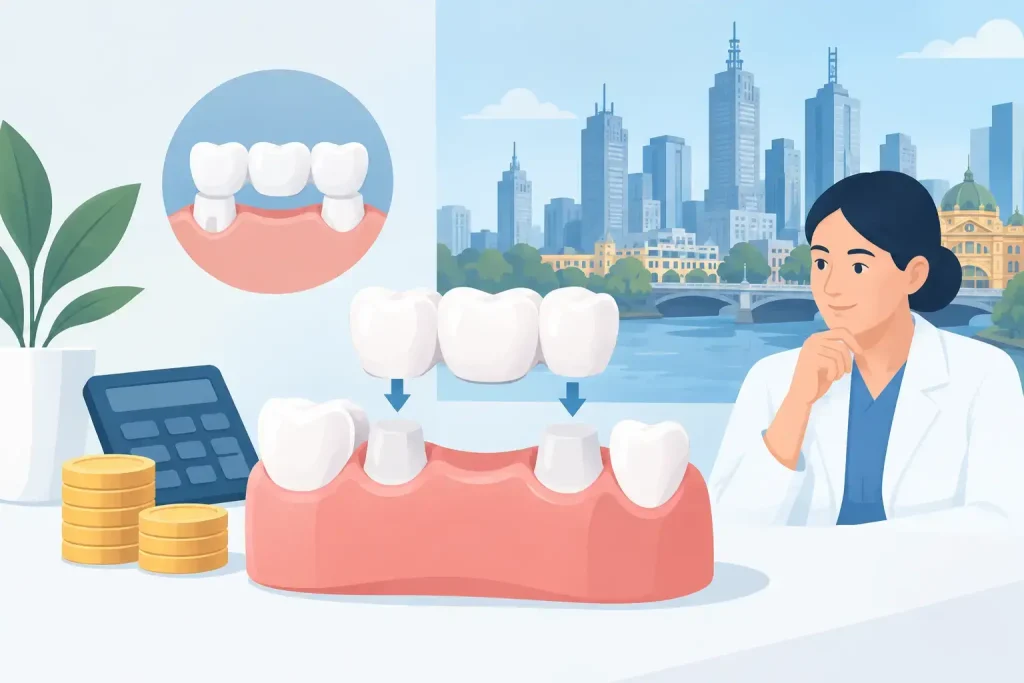
A dental bridge replaces one or more missing teeth by joining an artificial tooth, called a pontic, to neighbouring teeth or dental implants. For a conventional bridge, the teeth on either side of the gap are prepared for crowns. These crowns support the replacement tooth between them.
Bridges can be a practical choice when the neighbouring teeth already need crowns because they are heavily filled, worn or cracked. They can restore the appearance of a gap and help spread chewing forces more evenly. For some people, a bridge is also a quicker or more suitable option than implant treatment.
Before recommending one, your dentist should assess the supporting teeth, gums, bone levels, bite and the condition of the teeth opposite the space. This is especially important if you have gum disease, clenching or grinding habits, or several missing teeth.
Dental bridge cost: typical Australian pricing
In Melbourne, a conventional three-unit dental bridge commonly costs several thousand dollars. As a broad guide, many private dental practices may quote around $3,000 to $7,000 or more for a three-unit bridge. A simple resin-bonded bridge can cost less, while a larger bridge, a bridge involving complex preparation or a premium ceramic material can cost more.
These figures are only a starting point, not a promise of what your care will cost. Dental fees vary because each bridge is designed around the individual patient. A precise written estimate should follow a thorough examination and any necessary X-rays or scans.
It can be tempting to compare only the headline figure. However, a lower quote may not include treatment needed to stabilise the gums, rebuild a weakened supporting tooth, manage decay, provide a temporary bridge or adjust the bite. Knowing what is included makes it easier to compare options fairly.
What affects the final price?
The number of teeth being replaced is one factor. A bridge that replaces one tooth usually has three units: two supporting crowns and one replacement tooth. Replacing two or more teeth may require a longer bridge, which places greater demands on the supporting teeth and may involve more laboratory work.
Material also matters. Modern ceramic options can provide a very natural appearance, particularly for visible front teeth. Zirconia is known for strength and may be suitable in areas that take heavier chewing pressure. Your dentist will balance appearance, strength, available space and your bite rather than choose a material on price alone.
The health of the supporting teeth and gums has a major influence. If a tooth needs a filling, crown build-up, root canal treatment or gum treatment before it can safely support a bridge, that treatment is usually priced separately. Treating these concerns first can protect the bridge and avoid a more complicated problem later.
Laboratory craftsmanship, digital scanning, temporary restorations and review appointments can also form part of the fee. In selected cases, planned CEREC technology may support same-day crowns or bridges, but suitability depends on the size and position of the bridge, bite forces and the condition of the surrounding teeth.
The bridge options and their trade-offs
A conventional bridge is strong, fixed in place and widely used. Its main consideration is that the adjacent teeth must be shaped for crowns. When those teeth are already damaged or heavily restored, this can be a sensible way to restore the whole area.
A resin-bonded bridge, sometimes called a Maryland bridge, is often used for a front tooth. It has a discreet wing bonded behind a neighbouring tooth, so little or no drilling may be needed. It is more conservative, although it may not be right for heavy biting forces and can occasionally debond.
An implant-supported bridge is secured to dental implants rather than natural teeth. It may preserve adjacent healthy teeth and can be useful for larger spaces. It generally involves a higher upfront cost and a longer treatment timeline, as the implant needs time to integrate with the bone. Bone grafting, medical history and gum health can all affect suitability.
A removable partial denture may be a more affordable way to replace a tooth or several teeth, particularly while you consider a longer-term plan. It is removable for cleaning and may feel different at first. There is no single best replacement for everyone. The best choice is the one that protects your oral health, fits your priorities and is manageable for you to maintain.
Private health insurance and payment planning
If you have eligible extras cover, your private health fund may contribute towards a bridge. The rebate varies widely according to your policy, annual limit, waiting periods and the item numbers used for your treatment. It is wise to check your remaining annual limit before beginning, particularly if other family members are also using the policy.
A treatment plan should show the expected fees for each stage, including any preparatory care. Ask whether temporary teeth, review visits and future maintenance are included or separate. Clear pricing allows you to plan confidently rather than make a decision while you are in discomfort.
At Tooth Shine Dental, recommendations are based on what your teeth and gums need, not a rushed, one-size-fits-all approach. If there is more than one appropriate option, we can explain the benefits, limitations, expected fees and likely maintenance so you can make an informed decision.
Why gum health comes before a bridge
A bridge relies on its foundations. If the gums around the supporting teeth are inflamed or there is active gum disease, placing a bridge without addressing that disease can make cleaning harder and reduce its long-term outlook.
Gum assessment is not an add-on. It helps identify bleeding, plaque retention, recession, pocketing and bone loss around the teeth that would carry the bridge. Professional cleaning and targeted gum care may be recommended before restorative work begins.
Once a bridge is fitted, daily cleaning around and beneath the replacement tooth is essential. A toothbrush alone cannot clean every surface under a bridge. Your dental team can show you how to use floss threaders, interdental brushes or a water flosser where appropriate. Regular check-ups help detect small concerns before they become painful or expensive.
How long does a dental bridge last?
With good design, healthy supporting teeth and consistent care, a bridge can last many years. Some last well beyond a decade, while others need earlier repair or replacement. There is no guaranteed lifespan because mouths are different.
Grinding, biting hard foods, untreated decay, gum disease and missed maintenance visits can all shorten a bridge’s life. If you clench or grind your teeth, a custom night guard may be recommended to protect both the bridge and your natural teeth.
Contact your dentist if a bridge feels loose, painful or high when biting, or if you notice bleeding, bad taste, sensitivity or food constantly catching around it. A small issue may be straightforward to manage when checked early.
Questions worth asking at your consultation
Before you commit, ask why a bridge is being recommended over an implant or partial denture, whether the supporting teeth have a good long-term outlook, and what preparation is required. It is also reasonable to ask about the bridge material, the total estimated fee, your health fund rebate and the cleaning routine you will need at home.
A missing tooth does not always need the same solution as someone else’s. Taking time to understand the condition of your gums, bite and neighbouring teeth can make the decision feel far less overwhelming – and gives your new smile the best chance of serving you comfortably for years to come.