
A missing tooth can affect more than the look of your smile. It may change the way you chew, allow nearby teeth to drift and place extra pressure on other teeth. When comparing an implant versus dental bridge, the right choice is rarely about choosing the ‘best’ treatment in general. It is about choosing the option that best protects your gums, bite, budget and long-term oral health.
Both treatments can restore a gap with a natural-looking replacement tooth. The differences are in how they are supported, how treatment is carried out and what ongoing care they require. A careful examination, including an assessment of your gums and surrounding teeth, helps make the decision clearer.
Implant versus dental bridge: the key difference
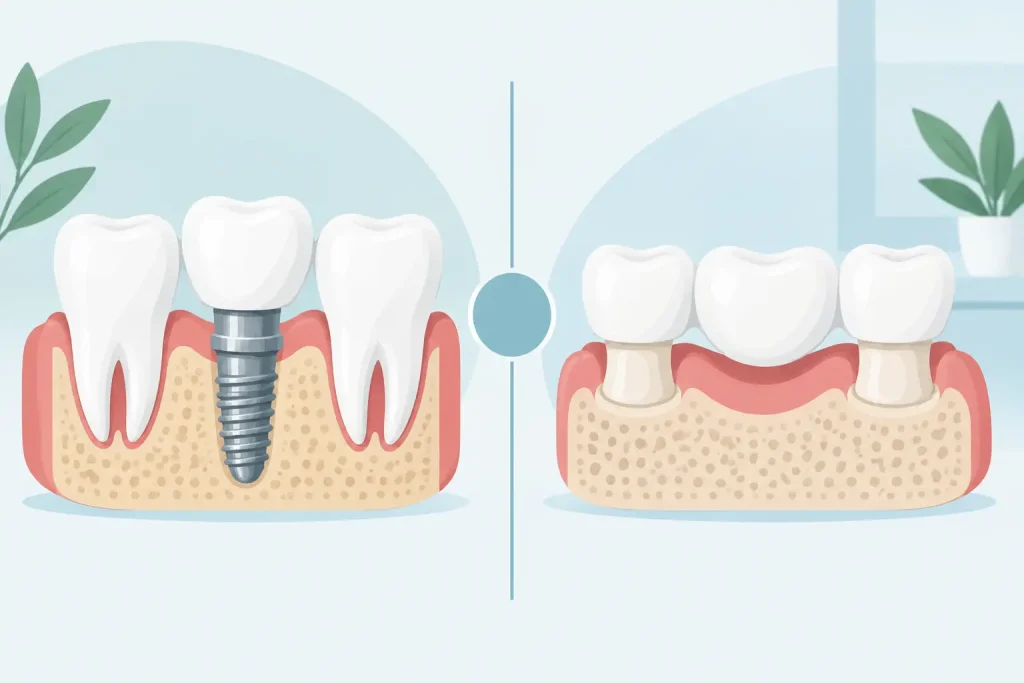
A dental implant replaces the root as well as the visible part of a missing tooth. A small titanium implant is placed in the jawbone, where it gradually bonds with the bone during healing. Once it is stable, it supports a crown designed to look and function like a natural tooth.
A dental bridge fills the gap by attaching a replacement tooth to one or more neighbouring teeth. In a conventional bridge, the teeth on either side of the space are prepared for crowns, and the replacement tooth sits between them. It is a fixed option, meaning it stays in place rather than being removed for cleaning.
Both can be excellent solutions. An implant stands independently, while a bridge relies on nearby teeth for support. That distinction often guides the conversation.
When a dental implant may be the better fit
An implant can be a particularly good option when the teeth beside the gap are healthy and have no need for crowns. Because the implant is self-supporting, those neighbouring teeth do not need to be filed down to hold a bridge.
Implants can also help maintain the jawbone in the area of the missing tooth. After a tooth is lost, the bone that once supported its root can gradually reduce in volume. An implant provides stimulation in that area, which may help preserve the bone over time.
For many people, an implant feels very similar to a natural tooth when chewing and speaking. It is cleaned by brushing and flossing around it, although implants still need regular professional checks. They cannot develop decay, but the gums and bone around them can become inflamed or infected if plaque is allowed to build up.
An implant is not always the quickest path. Treatment usually involves planning, placement, a healing period and then fitting the final crown. In some circumstances, bone grafting or gum treatment is needed first. This can make the process longer and increase the overall cost.
Good gum health is especially important. Active gum disease, uncontrolled medical conditions, heavy smoking and poor oral hygiene can affect healing and the long-term outlook of an implant. These factors do not automatically rule treatment out, but they need thoughtful management before proceeding.
When a dental bridge may make more sense
A bridge may be a sensible choice when the teeth beside the gap already have large fillings, cracks or existing crowns. If those teeth need protection anyway, using crowns to support a bridge can restore several concerns in one treatment plan.
Bridges are often completed sooner than implants because they do not require surgical placement and bone healing. This may suit someone who wants a fixed replacement tooth within a shorter timeframe, or someone who is not comfortable with implant surgery.
A bridge can also be appropriate where there is not enough bone for an implant and grafting is not preferred. It may offer a more straightforward option for some patients, particularly when their bite and surrounding teeth are favourable.
The trade-off is that a conventional bridge requires preparation of supporting teeth. Even strong, healthy teeth need to be reshaped to make room for crowns. A bridge also does not replace the missing tooth root, so bone changes can still occur beneath the replacement tooth over time.
Cleaning needs a little more attention. You cannot floss straight down between a bridge and the gum in the same way as individual teeth. Special floss threaders, interdental brushes or a water flosser may be recommended to clean underneath the replacement tooth and around the supporting crowns.
Comparing cost, time and long-term care
The upfront cost of an implant is usually higher than a bridge because it involves surgical placement, components and a final crown. However, a bridge may need replacement in the future, and the condition of its supporting teeth affects its lifespan. An implant and crown also require maintenance and may need repair or replacement over time.
Rather than focusing only on the first quoted figure, consider the likely care over the coming years. Ask what is included in the treatment plan, whether temporary teeth are needed, what maintenance appointments are recommended and which future costs may arise. Clear planning helps avoid surprises.
A bridge can often be completed in weeks, depending on the type of bridge and laboratory process. An implant commonly takes several months from placement to final crown, although the timing varies with healing, bone quality and whether additional treatment is required.
Neither option is maintenance-free. Daily brushing, careful cleaning between teeth and regular check-ups are essential for both. This is where healthy gums make a real difference. Bleeding gums, persistent bad breath or loose teeth should be assessed before replacing a missing tooth, not treated as an afterthought.
What about a temporary replacement?
While waiting for an implant to heal, a temporary tooth may be possible. Options vary depending on the location of the gap, your bite and the appearance you want during treatment. A temporary solution may also be useful while you consider a more permanent bridge or implant.
If the missing tooth is at the back of the mouth, a temporary replacement may not always be necessary. For a front tooth, appearance and speech are usually bigger considerations. Your dentist can explain what is practical and comfortable for your situation.
Questions worth discussing at your appointment
The decision becomes easier when it is based on your own mouth rather than a generic comparison. During an examination, your dentist will look at the teeth next to the gap, the health of your gums, the amount of available bone, your bite and how you clean your teeth at home.
It is helpful to ask whether the neighbouring teeth would benefit from crowns, how long each option is expected to take, and what maintenance will be needed. If anxiety, surgery, time away from work or cost are concerns, say so early. These are valid parts of treatment planning, not reasons to feel pressured into a particular option.
At Tooth Shine Dental, treatment planning is approached gently and without rushing. Digital imaging and a careful gum assessment can help show whether an implant, bridge or another option is appropriate, then allow time for you to understand the recommendation.
The right choice protects more than the gap
A bridge can be a practical, reliable restoration, especially when neighbouring teeth already need crowns or a faster fixed option is preferred. An implant can be an excellent long-term choice when bone and gum health support it, particularly if preserving healthy adjacent teeth is a priority.
The most helpful next step is a personalised assessment before the gap changes the position of other teeth or makes cleaning more difficult. With healthy gums, clear information and a treatment plan that suits your needs, replacing a missing tooth can feel like a calm and manageable decision.